Manchester UK based DBN Lighting has completed the design, supply and installation of lighting for the new “Da Vinci – the Genius” exhibition at the Museum of Science & Industry in Manchester.
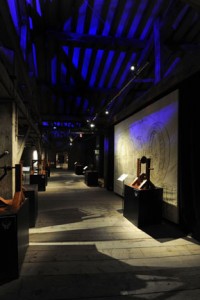
DBN was working for Grande Exhibitions from Melbourne Australia and also for MOSI, and the project was designed and managed for them by Nigel Walker. The Da Vinci Exhibition occupies most of the top floor of The 1830 Warehouse, a Grade 1 Listed timber frame building, originally completed in 1830 as the Manchester terminus of the Liverpool & Manchester Railway.
Da Vinci – The Genius features 4 rooms, some sub-divided and a small theatre space that the DBN team created with rigging and drapes, plus a separate area devoted solely to the Mona Lisa.
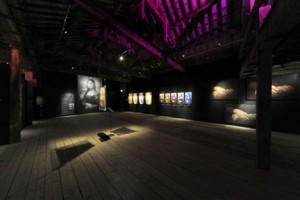
The major challenge was in rigging all the equipment without actually attaching anything directly to the building’s superstructure, and completing the installation within the stringent guidelines for preserving its integrity. Traditional fastening methods were therefore out, and points had to be created by carefully clamping around the main beams or via ‘soft’ suspension systems utilising steels clad with re-inforced flexible tubing to protect the wooden beams.
A combination of both these methods was used to fly scaffolding grids above each space, providing a very flexible working space onto which the lighting fixtures could be rigged.
For Nigel Walker, the exacting brief represented “Lighting heaven! It was a very satisfying job in which to be involved, we enjoyed the lateral thinking required and everyone is pleased with the results,” he says commenting on a truly stunning looking exhibition.
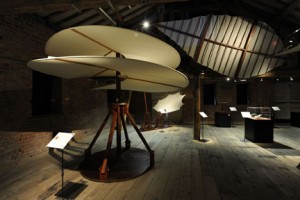
The lighting rig consists entirely of MR16 “Birdies” – over 260 of them in total – of varying wattages and beam angles. They are fitted with different frost and diffusion filters to add depth, mood and perspective to the exhibits, which are a mix of graphics panels, wooden models, prints and paintings.
There are only two colour filters used in the whole exhibition, which is Lee 203 1/4 CT blue, illuminating one picture, and producing a dramatically different effect. “The tungsten lightsource has worked extremely well,” states Walker, adding that all the lighting also runs off the existing house power distribution system with no need for additional control.
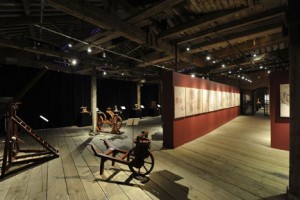
The DBN team were on site for a total of 3 weeks completing the work. The exhibition is open until June 2010, and is one of 4 carbon copies in different parts of the world.
Simultaneously, on the floor below, DBN also supplied lighting for a week long run of “The Difference Engine”, a show debuted during the Manchester International Festival in the summer. DBN’s Stephen Page was commissioned by producers Walk The Plank to design lighting for the performance that featured a giant spider puppet and the brain of mathematician/inventor/engineer Charles Babbage!

Leave a Reply